
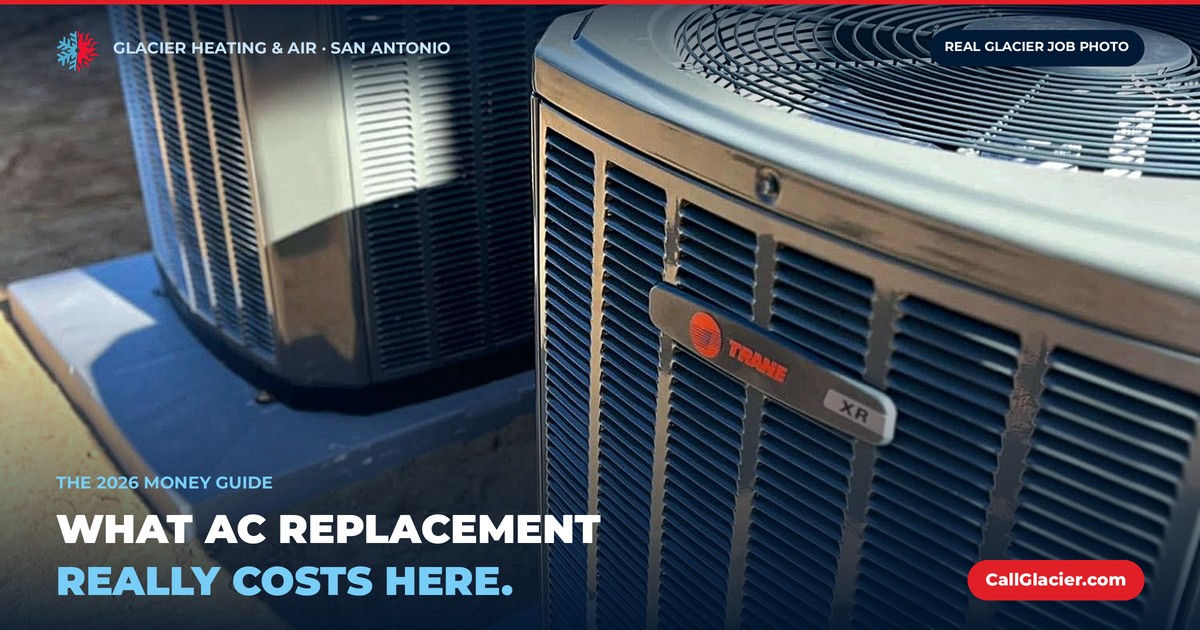
July 10, 2026 · 7 min read · Glacier Heating & Air
Nobody wakes up wanting to buy an air conditioner. By the time you're pricing one, you're usually hot, frustrated, and worried about getting taken for a ride. So here are straight numbers and the honest framework — the same one we walk homeowners through in person.
The short answer: most full replacements land between $6,000 and $14,000
For a typical San Antonio single-family home, a complete system replacement (outdoor condenser + indoor coil/air handler or furnace, installed) generally runs $6,000–$14,000. Smaller homes with simple installs can come in under that; large homes, high-efficiency variable-speed equipment, or jobs needing duct corrections can go above it.
Any company quoting you a precise price without seeing your home is guessing. What a real quote requires: your home's size and layout, the equipment tier you choose, and the condition of what the new system connects to — ducts, electrical, and the plenum.
What actually drives the price
Five factors explain most of the spread between a $6k install and a $14k one:
- System size (tonnage) — matched to your home by a load calculation, not guesswork. Oversized systems short-cycle and dehumidify poorly; undersized ones never catch up in August.
- Efficiency tier (SEER2) — base-efficiency equipment costs less up front; high-efficiency variable-speed systems cost more and give some of it back every month on your electric bill.
- Ductwork condition — leaky or undersized ducts can waste a big share of the new system's output. Sometimes sealing or corrections belong in the job; a good estimate separates that line item honestly.
- Installation quality — the unglamorous stuff (correct refrigerant charge, sealed plenum, proper airflow) determines whether the equipment ever delivers its rated efficiency. This is where cheap installs get expensive.
- Brand and warranty — reputable equipment with a real parts warranty and registered installation costs more than bargain-bin gear, and is nearly always worth it over a 15-year life.
The repair-or-replace rule we actually use
If your system is under 10 years old and the repair is routine — repair it. If it's past 12 years and the repair costs more than about a third of replacement — or it uses discontinued R-22 refrigerant — replacement usually wins the math.
One more input people forget: the electric bill. An aging system that 'works' can quietly cost you $50–150+ extra per month in peak summer versus a modern high-efficiency unit. Over a Texas cooling season, that's real money that belongs in the comparison.
How financing changes the picture
Most homeowners don't pay cash for a replacement. With approved financing, a typical system lands in the range of a monthly car-insurance payment — and the energy savings on a high-efficiency unit offset part of that note every month the AC runs.
We offer financing on qualifying installs and we'll show you the actual monthly math side-by-side with your current bill, in writing, before you decide anything.
How to not get burned (from people who see the aftermath)
A few rules that protect you no matter who you hire:
- Get the price in writing before work starts — and treat 'starting at...' pricing as a red flag.
- Ask for the load calculation. If they sized your system by eyeballing the old one, they skipped the most important step.
- Ask what happens to the ducts. A new system on leaky ducts is a sports car on flat tires.
- Confirm license and insurance. In Texas, HVAC contractors must be licensed — verify, don't assume.
- Same-day pressure discounts ('this price only if you sign now') are a walk-away signal. Real quotes survive a night's sleep.